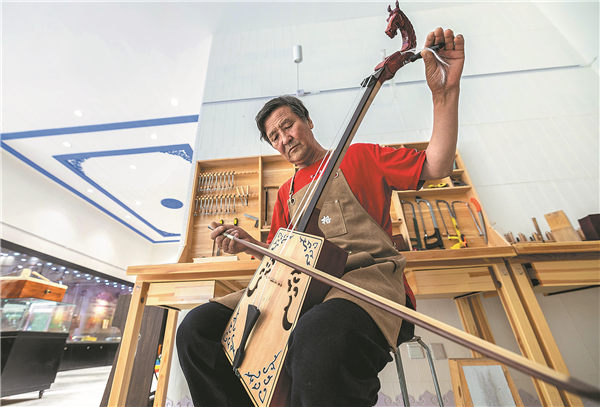
Morin Khuur
Introduction
The Morin Khuur, commonly referred to as the horse-head fiddle, is a traditional two-stringed musical instrument integral to the Mongolian culture. Its unique design, featuring a carved horse's head on its neck, reflects the deep connection between the Mongolian people and their equestrian heritage. The instrument's haunting melodies are a staple of traditional Mongolian music and are often used in ceremonies and festivals, as well as to accompany the art of khoomei, or throat-singing.
Historical Significance
The history of the Morin Khuur can be traced back to the era of the Tang (618-907) and Song (960-1279) dynasties, gaining prominence during the time of Genghis Khan (1162-1227). It has been a vital part of Mongolian nomadic culture, serving not only as a musical instrument but also as a symbol of Mongolian identity. In 2008, the Morin Khuur was inscribed on UNESCO's Representative List of the Intangible Cultural Heritage of Humanity, acknowledging its cultural importance and the need for its preservation.
Design and Construction
Traditionally, the Morin Khuur is crafted from wood, with its body often carved from a single piece of seasoned wood, chosen for its acoustic properties. The instrument is characterized by its trapezoidal soundbox and the distinctive horse's head carved on its neck, symbolizing the Mongolian people's reverence for horses. The strings, originally made from horsehair, are now sometimes substituted with nylon to improve durability while maintaining the instrument's traditional sound.
Musical Characteristics
The Morin Khuur produces a rich, deep sound that echoes the vastness of the Mongolian steppes. It is played with a bow, and its music can evoke emotions ranging from joy to melancholy. The instrument is versatile, capable of mimicking the sounds of nature and imitating the galloping of horses. It is often played solo or as part of an ensemble, particularly in performances that incorporate throat-singing, which adds harmonic depth and cultural resonance to the music.
Cultural Impact and Preservation
In Mongolian culture, the Morin Khuur is more than an instrument; it is a cultural ambassador that communicates the soul of the Mongolian people. It plays a significant role in ceremonies, rituals, and everyday life, reinforcing cultural traditions and values. Efforts to preserve and promote the Morin Khuur include educational programs in schools and cultural institutions in Mongolia and abroad. These initiatives aim to ensure that the intricate skills required to craft and play the Morin Khuur are passed down to future generations.
Contemporary Influence
Modern musicians and composers have embraced the Morin Khuur, integrating its sounds into various musical genres, from traditional folk to contemporary rock and orchestral compositions. Bands like Anda Union and Hanggai have popularized the Morin Khuur on international stages, showcasing its unique sound and its ability to bridge cultural divides through music. These contemporary adaptations highlight the instrument's versatility and its ongoing relevance in the global music scene.








